Five Minutes in Syria: The Object That Outran the Sensor
Most radar and infrared clips in the PURSUE collection show objects doing something recognizable, if extreme. They fly too fast, hover too long, or rotate in ways that challenge explanation. DOW-UAP-PR051 is different. It shows an object in forward flight, tracked by an infrared sensor for nearly five minutes as clouds stream past, before it pitches upward and accelerates off the right side of the frame at a speed that leaves the tracking system behind.
The video is five minutes and two seconds long. For most of that time, the object flies steadily enough. Clouds pass behind it. The sensor holds track. And then, in the final seconds, the object climbs and is gone, outrunning the reticle to the right with an acceleration profile that nothing in any known inventory can match. That combination, steady flight followed by instant departure, is what makes this one of the most analytically valuable clips in the entire Pentagon release program.
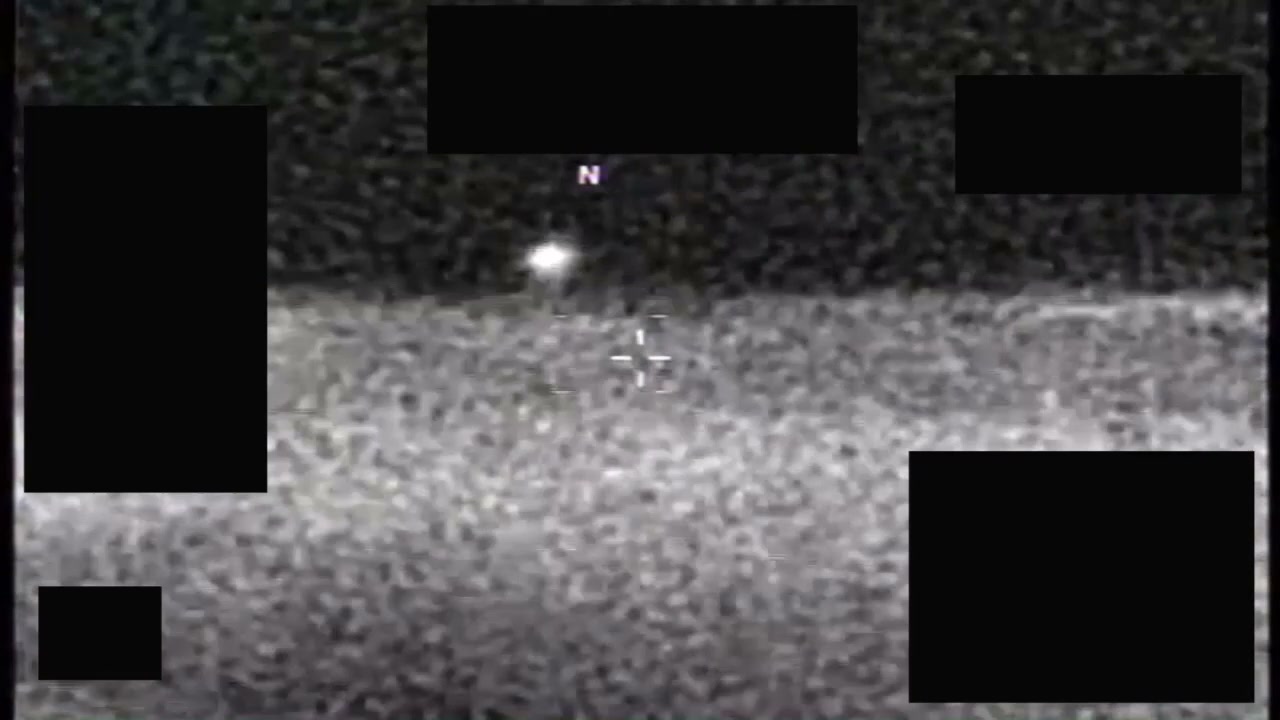
Frame from DOW-UAP-PR051 at approximately 1:00. The bright point source is tracked by the FLIR reticle against a scrolling cloud layer, confirming both the object and platform are in motion.
The Video
DOW-UAP-PR051: Syrian UAP Instant Acceleration
- Date: October 1, 2024
- Location: Syria (USCENTCOM area of responsibility)
- Sensor: Forward-looking infrared (FLIR), White Hot mode
- Resolution: 640×480, standard military FLIR
- Duration: 5:02 (302 seconds)
- Audio: None
- DVIDS: Video 1007707
- WAR.GOV: DOW-UAP-PR051
The title alone tells you this one matters. “Instant Acceleration” is not a term the Pentagon uses casually. The Defense Department’s official cataloguing system tagged this video with the specific kinematic behavior that makes it anomalous. Something in this footage moved in a way that warranted calling out the acceleration profile by name.
The Platform
We do not know what aircraft filmed this. The HUD overlays have been redacted with black rectangles so aggressive that nearly every piece of identifying information has been scrubbed. No tail number, no callsign, no coordinates, no altitude, no airspeed. The sensor mode (“WHOT”) is partially visible, and the tracking reticle is standard, but everything else is gone.
This level of redaction is notable even by PURSUE standards. The working assumption is a USAF or USN tactical aircraft operating in the USCENTCOM area of responsibility during a period of active combat operations. Syria in October 2024 was not a quiet neighborhood. Whatever this platform was doing when it encountered the object, the Pentagon decided that information was more sensitive than the UAP footage itself.
Phase One: The Flight
For approximately four and a half minutes, the object flies in a relatively steady manner. Clouds stream past in the background, confirming both the platform and the object are in motion. The sensor maintains tracking lock, the reticle centered on a small, bright point source in the infrared spectrum.
No structure is resolvable. No wings, no rotors, no fuselage. Just a dot of concentrated heat moving through the sky against a textured backdrop of cloud layers. The background scrolls continuously, giving a clear sense of speed and altitude.
There is no exhaust plume. No thermal signature consistent with a jet engine, a rocket motor, a piston engine, or electric motors driving rotors. The object simply moves, radiating in the infrared, with no visible means of propulsion.
Phase Two: The Departure
Somewhere around the 4:30 mark, everything changes.
The object pitches upward, climbing in the sensor’s field of view. The tracking reticle attempts to follow. Then the object accelerates hard to the right, moving across the frame at a rate that the tracking system cannot keep pace with. It crosses the entire field of view and exits the right side of the frame in a fraction of a second.
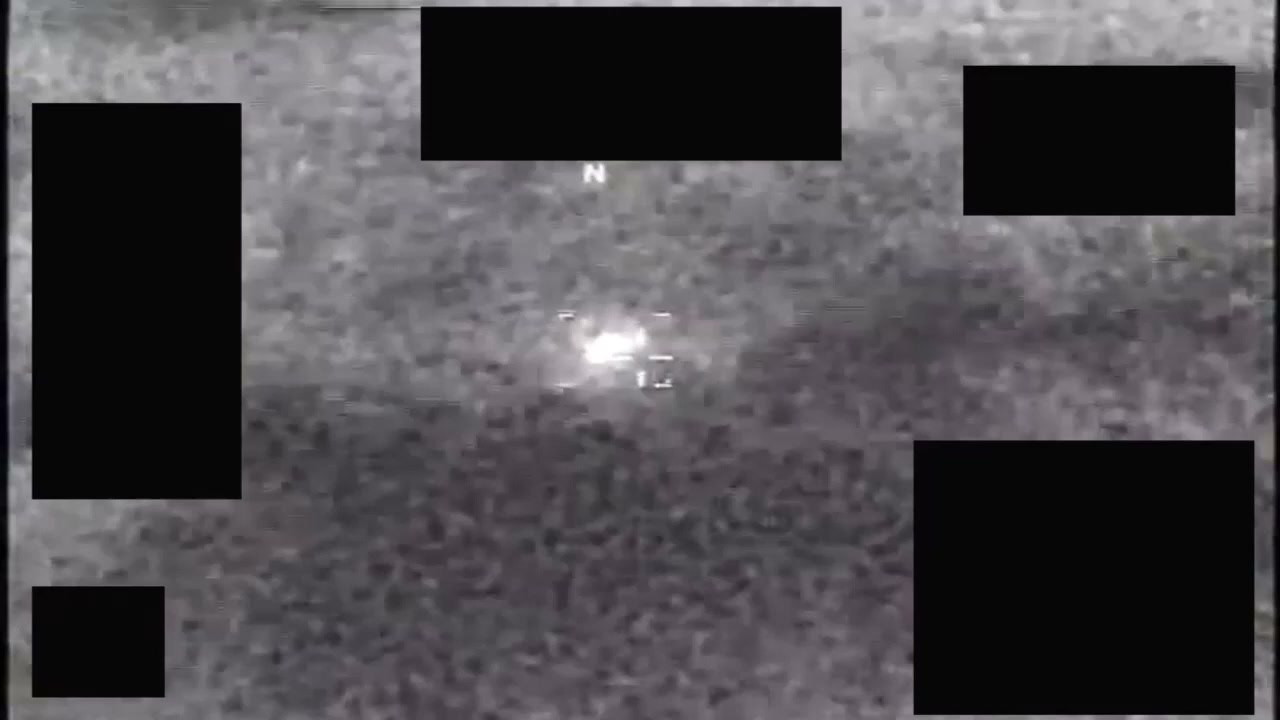
Frame from DOW-UAP-PR051 at approximately 4:40, during the departure sequence. The object has moved upward and is accelerating to the right.
This is not a gradual acceleration. There is no spool-up, no visible thrust trail, no heat bloom. The object goes from steady forward flight to extreme rightward velocity in what appears to be a single transition. The tracking system loses lock. The object is gone.
And here is the critical detail: the object had been stably tracked for over four minutes against a textured, moving background. This was not a sensor artifact or a momentary glitch. The FLIR system was following something real, something with mass and thermal signature, and then that real thing departed in a way that nothing in any known aerospace inventory can depart.
What It Is Not
The usual suspects do not survive scrutiny here.
Not a bird. No flapping signature in infrared. No bird maintains steady forward flight for four minutes matching an aircraft’s tracking system, then accelerates sideways out of a FLIR frame.
Not a balloon. Balloons drift with the wind. They do not maintain track with a military sensor for four minutes and then accelerate laterally at extreme speed.
Not a drone. Quadrotors produce visible motor heat. Fixed-wing drones cannot execute the observed maneuver: steady forward flight followed by an upward pitch and instantaneous lateral acceleration. No known unmanned system can cross a FLIR field of view that fast from a tracked, stable flight path.
Not a sensor glitch. The object was tracked for four and a half minutes against a moving cloud background. The background texture confirms the sensor was functioning correctly throughout.
Not a meteor or projectile. Meteors leave trails and follow ballistic trajectories. They do not fly steadily for four minutes and then change direction upward and laterally.
The Acceleration Problem
The departure event is the entire case. Everything else, the steady flight, the lack of visible propulsion, the point-source IR signature, is anomalous but could theoretically be explained by some combination of sensor limitations and an unknown platform. The acceleration cannot.
Going from stable forward flight to lateral departure velocity fast enough to cross the entire sensor field of view in a fraction of a second implies forces that would destroy any material constructed by human engineering. If the object has mass, and it must because it is visible in infrared, then accelerating that mass laterally at the observed rate requires energy release and structural integrity that have no parallel in known aerospace engineering.
This is the same kinematic signature that appears in other PURSUE cases. The pattern is small but consistent. Objects that fly in a stable manner, then depart with no observable acceleration curve. Either multiple independent sensor platforms across multiple years and theaters of operation are producing the same artifact, or something is actually doing this.
The Syria Context
This is not the only PURSUE case from the USCENTCOM area of responsibility. PR048 documents a separate Syrian UAP hover incident. PR049 and PR050 come from the same region and timeframe. The USCENTCOM AOR produced a disproportionate number of PURSUE cases relative to other combatant commands, which could mean more encounters, more reporting, or both.
Syria is interesting for other reasons. It is a crowded electromagnetic environment, with Russian, Turkish, Iranian, Israeli, and American systems all operating in close proximity. If you wanted to test an advanced platform against the world’s most sophisticated radar and sensor networks without being easily identified, the eastern Mediterranean theater would be a reasonable place to do it.
Whether that is what is happening here is speculation. What is not speculation is that an object was tracked for four and a half minutes over Syria by a US military infrared sensor, flying steadily with no visible propulsion, and then it pitched upward and accelerated off the right side of the frame in a way that nothing in any known inventory can replicate.
Source
- DVIDS: DOW-UAP-PR051
- WAR.GOV: DOW-UAP-PR051
- PURSUE Release: 02 (2026)
- DOD Asset ID: 111719715

Leave a Reply